all sport cars, american sport cars, approved buy car, sports used, audi sport car, audi sport cars, auto car, auto sport car, automotive car, best sport car, best sport cars
Lotus Exige 265E – British make, Lotus Exige 265E is special from other Lotus as it is able to run E85 ethanol and 95-octane unleaded fuel. The boosted 1.8-liter Toyota 4-cylinder inline engine makes 46 more horsepower than its non-ethanol counter part. It is the fastest car ever to leave the Lotus grounds and the first Lotus to promote the use of renewable energy sources at the same time
Lotus Exige 265E – British make, Lotus Exige 265E is special from other Lotus as it is able to run E85 ethanol and 95-octane unleaded fuel. The boosted 1.8-liter Toyota 4-cylinder inline engine makes 46 more horsepower than its non-ethanol counter part. It is the fastest car ever to leave the Lotus grounds and the first Lotus to promote the use of renewable energy sources at the same time
Proton-owned and British-based sports car maker Lotus has announced the Evora Type 124 Endurance Racecar (pronounced One Twenty Four). Based on the Evora road car, it is powered by a mid-mounted Toyota V6 powerplant. The engine is race-tuned and can output over 400PS, depending on race regulations. The power unit is linked to a 6 speed sequential transmission with steering wheel-mounted paddle shifters. It can weigh less than 1,200 kg, again depending on race regulations, thanks to an aluminium chassis, very strong lightweight forged aluminium wishbones and lightweight composite and carbon fiber panels.
Lotus Sports Cars Evora Type 124 Endurance Racecar
The Lotus Evora Type 124 Endurance Racecar has been developed from the award-winning Evora road car and is built to FIA regulations and safety standards. Based on the standard Evora road car, the Evora Type 124 (pronounced One Twenty-four) will make its 24 hour racing debut at the ADAC Nurburgring 24 hours race. According to Lotus, the Evora was designed for racing from the start and this made it very easy for the team to convert the Evora into a racecar, thanks to the mid-engine layout, stiff bonded aluminium chassis and lightweight forced aluminium wishbones for the suspension.
The Type 124 (pronounced One Twenty Four) Endurance Racecar is the next step in the evolution of the Evora. The car will make its 24 hour racing debut at the ADAC Nürburgring 24 Hours which provides a great test for the Evora’s performance, efficiency and durability under tough and demanding endurance race conditions.
The Evora gets a race-tuned version of the Toyota V6 mated to a 6-speed sequential paddle shift racing gearbox, and it now produces over 400 PS which is well over the 100 PS per liter ratio. I wish they’d listed out more specifications as to the specs of the engine – I dig this kind of stuff. In stock form, the Evora makes 280 horsepower from its 3.5 liter V6 engine, but even for the road car its said that a supercharged version could come later putting out over 400 horses.
At the heart of the Lotus Evora are fundamental racecar elements: mid-engine layout, high-tech and super-stiff extruded and bonded aluminium chassis and very strong lightweight forged aluminium wishbones. All these elements mean that it is a natural evolution from the road going Lotus Evora to a competitive endurance racecar.
From the outset the design team had intentions to take the Evora racing and the chassis was designed with this in mind. Endurance races are the perfect events to showcase the efficiency, handling and durability characteristics that have been fundamental to the concept of the Evora.
The Lotus Evora Type 124 Endurance Racecar has a race-tuned version of the mid-mounted Toyota V6 engine, with power increased to over 400 ps (depending on race regulations). Vehicle mass is expected to be reduced by up to 200 kg, bringing the weight of the racecar to less than 1200 kg (depending on race regulations).
Further changes for the Lotus Evora Type 124 Endurance Racecar include a six speed sequential paddle shift racing gearbox, full FIA specification roll cage, FIA-compliant 120 litre ATL fuel system, FIA fire extinguisher system, competition carbon fibre rear wing, diffuser and front splitter.
The racecar is fitted with AP Racing 6 piston callipers front and rear, with a race-tuned Bosch ABS system, 4-way adjustable dampers and adjustable anti-roll bars. The racecar runs on 18” rims shod with Pirelli racing slicks and the wheels widths have been increased over the roadcar to 9 ½ J on the front and 11 J on the rear.
Loads of goodies are added to the car – AP Racing 6 pot brakes on both front and back, a race-tuned Bosch ABS system, 4-way adjustable dampers, adjustable anti-roll bars, 18 inch wheels (nice and wide 9.5 from and 11 at the rear) with Pirelli slicks, a full FIA rollcage, an FIA 120 liter ATL fuel system, FIA fire extinguisher, yet weight is cut down from the production car to under 1200kg depending on race regulations. This is thanks to the use of carbon fiber extensively in the rear wing, diffuser, font splitter, and body panels.
The aerodynamically efficient Lotus Evora Type 124 Endurance Racecar body design, made from lightweight composite and carbon fibre panels, remains predominantly unchanged from the road car, with the only modifications being to the lower sections of the front and rear clamshells and the side sills.
Luke Bennett, Director of Lotus Cars Limited, said, “Motorsport has been in our blood ever since our founder, Colin Chapman, built the first Lotus back in 1948. We are proud of our motorsport history, which includes victories in Formula One, Le Mans, saloon car, rally car and sportscar racing around the world; more recently, we won the British GT3 Championship in 2006 with the Lotus Exige. The Lotus Evora Type 124 Endurance Racecar is from the same unique stable and we expect it to be a competitive racecar when we enter various endurance races next year.”
Roger Becker, Vehicle Engineering Director for Group Lotus Plc said, “Every Lotus car is designed to be at home on the race track as well as the road, and the Evora is no different. Designed primarily as an everyday road car, the Evora’s lightweight and stiff structure, its aerodynamics and performance means that it is perfectly suited to taming race tracks around the world, and we are looking forward to seeing the new Lotus Evora Type 124 Endurance Racecar line up on the grid for the 2010 season.”
The racecar is expected to compete in a number of endurance races in 2010/ 2011 forming part of a factory-supported race program. The races that are targeted are: The 2010 ADAC Nürburgring 24 Hours (Nürburgring Nordschleife, Germany) in May 2010, Merdeka Millennium 12 Hours (Sepang, Malaysia) in August 2010, BritCar 24 Hours (Silverstone, UK) in October 2010 and the Dubai 24 Hours (Dubai Autodrome, UAE) January 2011.
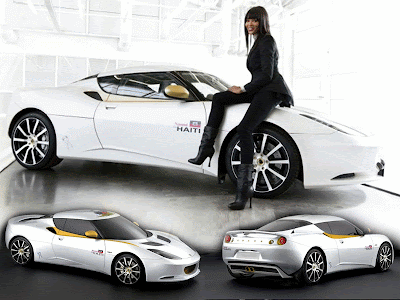
In response to the horrific natural disaster that has crippled the nation of Haiti, Naomi Campbell together with Lotus Cars will be auctioning eight special edition "Naomi for Haiti" Lotus Evora sports cars, with the proceeds from the auction going to help the relief effort in Haiti on 12th of January 2010.
2010 Naomi for Haiti Lotus Evora Sports Cars
The Lotus Evora Naomi for Haiti has to be one of the most expensive special edition ever to come out of the company's plant. The firs two Lotus Evora Naomi for Haiti units have been auctioned for more than 300,000 GBP each at The Fashion For Relief Event. The first Lotus Evora Naomi for Haiti was bought by Naomi Campbell’s boyfriend, Vladimir Doronin for no less than 320,000 GBP.
The remaining five Lotus Evora Naomi for Haiti will be auctioned starting from today on the supermodel's website at www.naomiforhaiti.com. The highest bidders and the new owners of the remaining five Lotus Evora Naomi for Haiti cars will be announced at the Lotus press conference on the 2nd of March at the Geneva Motorshow.
The Lotus Evora is a very desirable, multi-award winning, high performance, mid-engined sports car that presents a fantastic piece of design to bid on. The “Naomi for Haiti” Evora sports car has been specially designed by Lotus Design Director Donato Coco and reflects Naomi’s design direction. The bespoke styling combines the flag of Haiti with a dramatic colour scheme and the cars include a full range of options, meaning these cars will all become desirable collectors items.
The “Naomi for Haiti” Evoras will be auctioned at Naomi Campbell's Fashion for Relief TM charity fashion show on the 18th of February at the London Fashion Week venue at Somerset House. The remaining “Naomi for Haiti” Evoras will be entered into an auction run on the “Naomi for Haiti” website Charity Auction - Naomi For Haiti and bidding will commence at 0800 GMT on the 19th of February and will end at 1200 noon GMT on 28th of February 2010.
According to Naomi, Lotus Cars has been Fashion for Relief’s biggest supporter and has been instrumental in helping us to raise crucial funds for The White Ribbon Alliance and its partners in Haiti. Still according to her, to have Lotus on board supporting Fashion for Relief is very important to Sarah Brown, myself and everyone at The White Ribbon Alliance and we are truly very grateful.
Naomi Campbell says, "I am deeply saddened by the recent tragedy in Haiti. So many have been killed and severely affected by the earthquake - women and children in particular are most vulnerable in disasters. Fashion is universal, personal and touches everyone. I am delighted that Lotus Cars is supporting my Fashion for Relief TM charity and I am sure with such generous help we will raise crucial funds to help save the lives of women and children."
Lotus CEO, Dany Bahar said “It was a great pleasure for Lotus to work with Naomi and the White Ribbon Alliance for this excellent cause and we are delighted that by working with Naomi, our suppliers and the generosity of the bidders, we have been able to raise such a significant sum of money to help those in need during this difficult time.”
It was announced on March 11, 2010 at the 80th Geneva Motor Show that the eight special editions of the Lotus Evora Naomi for Haiti have achieved in excess of €1.4m at auction.
The multi-award winning Lotus Evora provides the basis of the stunning carbon design concept unveiled at the 80th Geneva Motorshow. The car boasts a stylish carbon fibre, leather and alcantara interior, aggressive carbon diffuser and an evocative high tech composite body.
2010 Lotus Evora Carbon Concept
The head turning looks of the Evora Carbon Concept car provide a more purposeful, planted stance with the car looking lower and more aggressive. This styling direction is continued with a structural carbon fibre roof, Lotus Motorsport influenced carbon diffuser and carbon splitter. The Evora Carbon Concept car retains the same class leading handling and high tech aluminium bonded and extruded chassis of the production car.
2010 Lotus Evora Carbon Concept
Donato Coco, Director of Lotus Design announced, “The design of the Evora Carbon Concept car features exotic, high tech materials offering a good synergy with the Lotus brand image, expressing our motor sport heritage and history of stylish sports cars due to which Lotus are renowned”.
2010 Lotus Evora Carbon Concept
Carbon fibre panels with perforated leather and Matt Alcantara are featured in the interior. For example, the dashboard, footwell and inner roof are covered in Alcantara, while exposed carbon fibre can be seen on the centre console, air vents and others. It sports a carbon fibre roof, 19-inch alloy wheels with 235/35 front and 285/30 rear Pirelli P-Zero Corsa tyres.
2010 Lotus Evora Carbon Concept
While no engine tweaks have been mentioned, the drop in weight means the Toyota-sourced 3.5-litre V6 has a lot less mass to move thus performance has been significantly boosted. Be on the look-out for a production version of the Evora Carbon Concept in the not-too-distant future.
This is the 2010Lotus Evora 414E Hybrid, a new car that made its debut today at the Geneva Motor Show which aims to demonstrate how a hybrid car can have breathtaking performance from a highly efficient propulsion system. Lotus Evora 414E Hybrid is a full hybrid vehicle, which comes with twin electric motors.
2010 Lotus Evora 414E Hybrid
The new 414E Hybrid uses a high performance drivetrain system consisting of twin motors each delivering 204 hp (152 kW or 207 ps – this inspired the name 414E) and 400 Nm (295 lbft) of torque to each wheel via independent, single speed, reduction transmissions. With these numbers the car can accelerate from 0 to 60 mph in just 4.0 seconds.
2010 Lotus Evora 414E Hybrid
The Evora 414E Hybrid is a concept car that is equipped with a 7-speed transmission and two drive settings, including Eco and Sport. The vehicle is mainly maid in a copper color, which is used not only in the exterior but also interior of the concept, including the instrument panel, seat covers and brake calipers.
2010 Lotus Evora 414E Hybrid
The new car can be charged via a typical household plug or the car’s onboard generator. An additional range is provided by the Lotus Range Extender engine, an optimised 1.2 litre, three-cylinder engine capable to deliver (48 ps/47 hp). The Lotus Evora 414E Hybrid has a total range of 480 km (300 miles) and can be driven as a fully-electric car for about 56 km or 35 miles.
2010 Lotus Evora 414E Hybrid
Also, the car features HALOsonic Internal and External Electronic Sound Synthesis technologies from Lotus and Harman International, which means that it will provide sound contouring within the cabin and improve pedestrian safety outside the vehicle. The car comes with a sports mode that can simulate a 7 speed, paddle shift transmission combining exceptional driver involvement for a hybrid sports car.
2010 Lotus Evora 414E Hybrid
Dr Robert Hentschel, Director of Lotus Engineering said: “Innovation has always been at the heart of Lotus and is needed now more than ever. The Evora 414E Hybrid is the perfect demonstration of Lotus Engineering’s core competencies: lightweight architectures, efficient performance, electrical and electronics integration and driving dynamics.
2010 Lotus Evora 414E Hybrid
The technology demonstrator represents an encapsulation of the advanced technologies that Lotus Engineering continues to develop to overcome the current environmental challenges facing the automotive industry and showcases the future direction that the sector is taking and why Lotus Engineering is perfectly placed to lead the technological development in this area.”
The Special Edition Lotus Elise Club Racer introduces new and exclusive colour schemes, bespoke interior and lightweight components all in a world class, high performance and low emission sportscar.
Lotus has taken four of the classic colour schemes used by Lotus in the 1960s (Elite Yellow, Carbon Grey, Sky Blue and Old English White) and combined them with exclusive Club Racer interior design features to give a stunning sportscar that beautifully morphs function and form. The firm and supportive Lotus Elise seats are clad with lightweight microfibre comfort pads perfectly positioned to give the right amount of support with the minimal amount of weight, but still keeping the body coloured seat shell partly exposed.
The exterior body colour theme is carried over to the transmission tunnel and combined with silver and black paint highlights, bisecting the cockpit and tying together the whole sporty theme unique to the Lotus Elise Club Racer.
Other exclusive interior design features of the Lotus Elise Club Racer are the anthracite anodised gear knob and handbrake sleeve, the Club Racer (CR) logo hand embroidered on the seat headrest and the unique anodized aluminium flooring in the driver's and passenger's footwell. The small 320 mm diameter leather rimmed steering wheel has an on-center marker, enabling the more spirited driver to quickly and safely identify the straight ahead position of the front wheels.
The lightweight six spoke alloy wheels, shod in bespoke Yokohama AD07 LTS tyres are also anthracite anodised, complementing the key interior components. Luke Bennett, Director of Lotus Cars said, "Special Editions of the award winning Lotus Elise have always proved popular with our customers around the world, and I expect the Lotus Elise Club Racer to be no different. We have taken colour schemes from our past, used on the Elite and Elan in the 1960s and cleverly brought them up to date with a modern feel to the interior. The whole design package is modern with a classic twist, which of course matches the peerless ride and handling of a Lotus and the convertible experience of the Elise perfectly."
The first all-new Lotus since the iconic Lotus Elise made its debut in 1995, The Lotus Evora enters the sports car market as currently the world's only mid-engined 2+2. Powered by a Lotus-tuned 3.5-litre V6 engine producing 280 PS, and weighing just 1350 kg (prototype specification), the Lotus Evora promises breathtaking performance. During preliminary testing around the famous Nürburgring, the Lotus chassis engineers report that it is extremely agile and great fun to drive - even when clad with the full development disguise that hid the beautiful lines from the prying motor-industry paparazzi.
In addition to its excellent performance and exemplary handling, the Lotus Evora offers a more refined ownership experience than Lotus's existing smaller four-cylinder models. Its elegantly styled cabin is elegantly trimmed and its equipment list includes contemporary features such as an advanced touch-screen multi-media system and electric power-fold door mirrors.
Because one of the roles of the Lotus Evora is to attract new customers to the Lotus brand, much attention has been paid to its ease of use. Wider, taller door apertures and narrower sills make getting in and out of the cabin a less athletic undertaking than it is in Lotus's smaller sports cars (the Elise, Exige, Europa and 2-Eleven), while the design of the cabin itself will accommodate two 99th percentile (6ft 5in tall) American males in the front seats. The 'convenience factor' of the Lotus Evora extends to less obvious areas of the car. For instance, beneath the skin the entire front-end structure is a high tech aluminium sacrificial modular unit, attached to the main extruded aluminium tub. This modular unit is designed to deform for maximum safety, and to reduce repair costs in the event of a frontal impact. The Lotus Evora has been designed with global automotive regulations in mind, and future derivatives are planed, these including amongst others, a convertible.
THE LOTUS EVORA IN DETAIL The Style or function? Have both... Designed 'in-house' by Lotus Design, the sleek and athletic form uses fluid forms and crisp surfaces to communicate velocity, agility and sophistication. Low and wide with modern cab forward proportions, muscular rear haunches and function optimised hip air intakes this is clearly a serious mid engined sportscar that skilfully hides the practicality of its two plus two capability. Ingress and egress, for example, dictated a minimal "step-over" to get into the Lotus Evora. We simply cut away the surface under the door and created a unique and dramatic piece of sculpture that enhances the stance of the car as well as its useability.
Elsewhere, aerodynamic considerations for drag, down force and cooling had significant but positive influence on the overall form and details such as air intakes. A desire to create balanced down force, that increases cornering performance, led to the adoption of, the now, "signature" top exit radiator vent, race car inspired diffuser and "floating rear wing". Drag limitation, drove the dramatic tear-dropped cabin layout and the curvaceous plan view has given the car a more muscular rear shoulder and conveys a level of sophistication appropriate to this market segment. This inherent understanding of the relationship between the technical and the aesthetic paid dividends the first time a full-scale model of the Lotus Evora was wind-tunnel tested - only minimal adjustments were required to the car's aerodynamic package to meet the targets for downforce and stability. The view from the rear three-quarters is just as striking and the one that many will become familiar with as the car passes them on the road. The tapered cabin, diffuser, floating wing, centrally mounted twin tailpipes and distinctive engine bay vents all combine to create a completely unique look. The design language of the interior reflects that of the exterior - simple, fluid surfaces, soft forms and crisp feature lines wrap around the cabin cosseting the occupants. Unlike recent Lotus products that use a race car inspired, technical minimalism, the Lotus Evora employs a softer approach that utilises premium quality materials and finishes to create a contemporary but luxurious ambience that is unique to Lotus products. Focused courtesy lighting is used throughout the interior, giving a spectacular illuminated feel to the sculpture design feature of the cabin.
High-tech treats Contemporary technology also features in the Lotus Evora's cabin. A newly developed Alpine multi-media system with a 7 inch touch-screen provides advanced audio, satellite navigation, video, Bluetooth® hands-free telephone and iPod® connectivity functions; the screen also serves as a monitor for the Lotus Evora's optional reversing camera. The satellite navigation element of the system is removable, allowing you to programme it from the comfort of your home, or take it with you to continue your journey in an unfamiliar pedestrian location. The Alpine audio set-up is one of the most sophisticated automotive systems in the world. Called IMPRINT and using MultEQ sound enhancement technology, it is able to cancel out sound imbalances, caused by the cabin window glass, for instance, creating echoes, while carpets suppress mid-range frequencies - resulting in amazingly crisp, clear, undistorted sound reproduction wherever you are seated in the car. A bespoke air-conditioning system developed by Bergstrom is standard on all models, and has been designed for the hottest climate or the closest humidity to help provide maximum occupant comfort. Lotus traction control and on-board tyre pressure monitoring will also be available.
One size fits all The front seats themselves are very supportive and leather clad with a lightweight manual adjustment mechanism for fore and aft, rake and lumbar, designed to give a supported driving position. The rear seats of 2+2 versions of the Lotus Evora are intended for children and smaller adults. There will also be a two-seater derivative with a luggage shelf in the back. To maximise comfort in the rear, there's a decent amount of foot-room under the seats in front, while both back seats feature ISOFIX mountings for secure child seat fitment. When unoccupied, the rear seats provide a convenient stowage area, adding to the Lotus Evora's appeal as an everyday car. The 160 litre boot, which ingeniously features a fresh air cooling system to reduce the effect of any heat ingress from the engine bay, will also accommodate a full set of golf clubs. Easy in, easy out With the Elise and its derivatives, the no-compromise character of the car makes getting in and out across a wide sill and through a comparatively narrow door/window aperture part of the charm of ownership. For the Lotus Evora and its remit for the serious daily driver, and to attract newcomers to the Lotus brand, greater convenience and practicality is provided. As a consequence the sill is now lower and slimmer (80mm wide compared with 100mm in the Elise), and the whole door aperture taller. The doors open wider than on the Elise and its siblings, while the height of the front seat is raised by 65mm. But while the Lotus Evora is undeniably more 'lifestyle' in respect of its everyday practicality, once you're seated behind its flat-bottomed steering wheel, it feels every bit as exotic and sporting as you would expect a Lotus to be.
Safely does it In common with the Elise and its derivatives, The Lotus Evora's bonded extruded aluminium chassis tub has incredible inherent strength, particularly in regard to side impacts. Additional torsional strength is given to the whole structure by the tubular steel seatbelt anchorage frame that also acts as a rollover structure. Deformable sacrificial aluminium front and steel rear subframe modules are attached to the tub using joints which are designed to minimise damage to the tub, protecting the main passenger cell in the event of an accident.
Driver and passenger airbags are standard. The airbag on the passenger side is cleverly engineered to deploy vertically and then be deflected rearwards by the windscreen, to provide protection for children as well as adults. Anti-lock brakes are standard on all models, as is Lotus Traction Control (LTC); these systems have been specially developed in co-operation with Bosch and enable up and coming drivers to consistently exploit the braking and acceleration capabilities of the Lotus Evora, whilst allowing skilled enthusiasts the freedom to enjoy the full Lotus driving experience.
The chassis: Production Low Volume Versatile Vehicle Architecture The Lotus Evora's chassis is an evolution of the Versatile Vehicle Architecture (VVA) from the Lotus APX concept vehicle previously showcased at the Geneva Motorshow, and allows for the development of a range of vehicles up to a gross vehicle weight of 1,900 kg. This architecture has been designed to be more applicable to mid-volume applications by utilising our low capital investment manufacturing processes. The Lotus Evora structure progresses the Lotus 'bonded and riveted' technology used in the Elise family of vehicles with unique extrusions and folded panels, whilst providing contemporary ease of ingress/egress, build modularity and improved, lower cost repairs.
The Low Volume VVA architecture has been designed so that it can be extended in width, length and height. The strength and stiffness of the low volume VVA chassis can be modified cost effectively by varying the wall thickness of the extrusions, without altering the exterior dimensions. The ability to lengthen or shorten extrusions with the option to tailor the chassis stiffness, vastly increases the number of vehicles that can be developed from this vehicle architecture. Front and mid engine installations have been considered, as well as hybrid and Electric Vehicle (EV) applications. The Lotus Evora employs a composite roof as a stressed structural member to give an exceptional vehicle stiffness of 26,000 Nm per degree, thanks in part to the seatbelt anchorage frame's secondary function as a roll over structure, and partly because the high-tech composite body panels are stressed items. However, despite this high stiffness, the complete chassis and modules weight just 200 kg (prototype weight), helping to keep the weight of the whole car to just 1350 kg (prototype weight).
To deliver this high performance structure, bonded and riveted high grade aluminium extrusions and simple and elegant folded sheet elements are used in the lower structure, building upon award winning research projects in this field. Lotus pioneered the technology of bonded aluminium extrusions for use in road vehicles and has successfully developed high performance cars for other car companies around the world. The central tub is attached to an extruded aluminium subframe at the front and a lightweight welded steel subframe at the rear. These subframe modules also offer advantages in terms of convenience and low cost of repair, and during manufacturing can be brought to the production line fully assembled, ready to be attached. The high technology Lotus Evora chassis will be manufactured at the new Lotus Lightweight Structures facility in Worcester, UK. LLS employs 120 skilled engineers, technicians and sales staff and will manufacture all the Lotus aluminium structures, including those for the Elise, Exige, 2-Eleven and Europa and aluminium and composite structures and components for Lotus's extensive global client base.
The Suspended & animated The Lotus Evora suspension wishbones are forged from aluminium to reduce the unsprung mass. These are similar in weight, and stiffer than the steel items found on the much smaller Elise, Exige and Europa vehicles, and have a far higher vehicle weight capacity. They are attached to the front and rear modules via bespoke bushes. The Lotus Evora will use Bilstein high performance dampers and Eibach springs with unique dual path top mounts for optimised vehicle refinement. Hydraulically assisted power steering is provided by a Lotus tuned TRW steering rack. All in all, the Lotus Evora delivers. It has incredible Lotus handling and provides unsurpassable driving pleasure. In fact, word from the ride and handling team is that the new car is likely to become a class standard-setter for speed and agility. Stop right now... Vented and cross-drilled brake discs - massive 350mm items on the front and 332mm at the rear - and high performance bespoke Lotus AP Racing 4 pot callipers ensure impressive stopping power. Everyone connected with the brake testing programme, conducted on the punishing corners, climbs and descents of the Nürburgring, has described the brakes as 'phenomenal' with excellent thermal performance and outstanding feel even after extended sessions of extreme use. Part of that testing programme was to finalise settings for the ABS system being developed in conjunction with Bosch. The system is set to very high thresholds and operates so progressively that drivers are often unaware that they have actually triggered the ABS.
Safe. Fun. Lotus Traction Control The Switchable Lotus Traction Control (LTC) system has been developed simultaneously with the ABS and works through the engine management system to reduce power when required to maintain traction. Unlike many traction control systems, LTC has been tuned to complement the skills of the driver without taking over. The Lotus LTC is active above 5 mph (8 km/h) and operates much more quickly than many brake based systems. The system can be deactivated completely, giving no traction control intervention.
Keeping a grip - 18 inch at the front, 19 inch at the rear Tyre choice is a vital component in the handling performance of every Lotus and for the Lotus Evora, Yokohama was chosen as development partner. Lotus's long-term relationship with Yokohama was swiftly rewarded during development when initially the front tyre size did not generate the Lotus required lateral grip, the Japanese grip gurus went away and developed bespoke tyres especially for the Lotus Evora - a 225/40 ZR18 at the front and larger diameter; 255/35 ZR19 at the rear. Both have carcass construction and a rubber compound unique to Lotus and are identified by the letters 'LTS' on the sidewalls.
The V6 Engine - dual VVT-i ('intelligent' variable valve timing) The exceptional working relationship that Lotus has enjoyed with Toyota over several decades, combined with the overwhelmingly enthusiastic reception for the company's four-cylinder power units in the Elise and Exige, guaranteed the Japanese giant's inclusion on the shortlist for the Lotus Evora engine supplier. The final choice was Toyota's all-alloy 2GR-FE 3.5-litre V6 DOHC, with dual VVT-i ('intelligent' variable valve timing). Lotus has painstakingly developed its own T6e engine management software for this engine to optimise its compatibility with the unique requirements of the Lotus Evora to give a peak power output to 280 PS at 6400 rpm, while boosting its maximum torque to 342 Nm at 4700 rpm (prototype figures). Changes to the engine management and exhaust systems also allow the V6 to rev more freely and provide rapid throttle response; feedback from the development team suggests that the strength of the engine's mid-range torque means that gutsy performance will be easily accessible without having to thunder through to the redline. This makes the Lotus Evora a thoroughly satisfying car for everyday road use and a rewarding one when you just want to drive.